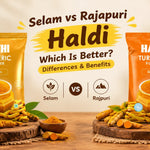










Selam vs Rajapuri Haldi: Which Is Better? Differences & Benefits
 Sagar Dubal

19 October 2026
Many people get confused about Selam vs Rajapuri haldi powder because both packs promise the best colour and quality.
The only difference is price and description. So, which haldi should you buy? Is Selam haldi better for daily dal, or should you choose Rajapuri haldi for kadhi, a few curries, and turmeric milk?
The answer depends on what you cook, the color, and the batch's quality. A turmeric variety's name can’t tell you everything about its active compound content or purity.
This blog compares both varieties in simple terms, explains what research says, and helps you choose the best haldi powder for your family.
Selam or Rajapuri Haldi
Selam haldi is associated with Tamil Nadu and is popular for its golden-yellow color.
Rajapuri haldi is associated with Sangli, Maharashtra, and is often known for its richer yellow-orange colour.
You can use both in daily Indian meals. Curcumin content can vary by batch and testing method, so always rely on reliable evidence rather than buying haldi based on the variety name.
Selam vs Rajapuri Turmeric at a Glance
|
Feature |
Selam Turmeric |
Rajapuri Turmeric |
|
Common names |
Selam haldi or Salem haldi |
Rajapuri haldi |
|
Associated Regions |
Selam, Tamil Nadu |
Sangli, Maharashtra |
|
Rhizome appearance |
Mustard yellow |
Saffron yellow |
|
Colour of powder |
Linked with a golden-yellow shade |
Linked with a yellow-orange shade |
|
Curcumin |
Research varies by sample and method |
Research varies by sample and method |
|
Everyday cuisine |
Dal, rice dishes, sabji and curries |
Dal, rice dishes, sabji and curries |
|
Special usages |
Perfect for dishes that need a golden-yellow colour |
Best to use when you want a deeper yellow shade |
|
Best approach to purchase |
Look for freshness, ingredient list, and quality proofs |
Look for freshness, ingredient list, and quality proofs |
What Is Selam Turmeric (Salem Haldi)?

Where does Selam turmeric grow?
Selam is a popular area in Tamil Nadu where turmeric is grown. But the name ‘Selam’ also indicates a turmeric variety grown outside the district.
Packets labeled as Selam turmeric don’t prove where the turmeric was grown based on the name alone.
If you really care about the growing region, always check the label and sourcing information mentioned on the pack.
Selam, Salem, and Selam Gattha: What is the Difference?
You might see packets labeled Selam or Salem while purchasing turmeric. These names generally refer to the same variety of haldi in the spice trade. There is one more term: Selam Gattha.
These names can confuse online shoppers, especially when sellers use different spellings. So, before you compare any 2 products, always check whether they’re actually different varieties.
The name alone doesn’t prove a powder is pure, potent, or better than another.
What do Selam haldi look and smell like?
A few published studies describe Selam haldi rhizomes as mustard yellow. After drying and grinding, the powder is generally golden yellow.
But the final color depends on more than the variety. Turmeric age, processing, grinding method, and storage also affect its look and fragrance.
Home test: Check that the powder has a fresh, classic turmeric aroma. Avoid packs with a dusty or unusual aroma, damaged packaging, or an unclear ingredient list.
Hathi Masala Selam haldi powder is best for people who want to explore this variety.
What Is Rajapuri Turmeric (Rajapuri Haldi)?

Where does Rajapuri turmeric grow?
Rajapuri haldi generally grows across Sangli district in Maharashtra. It is named after the Rajapur port.
Sangli turmeric also has a registered Geographical Indication (GI) tag. This tag recognizes haldi's roots in the region and the unique qualities that make Rajapuri turmeric special.
But the name Rajapuri written on a packet doesn’t automatically prove that the product is authorized to use the GI tag. To make this claim, the product must meet a few applicable requirements.
What makes Rajapuri haldi look special and different?
Some studies describe Rajapuri rhizomes as saffron-yellow and thicker, with relatively thin skin. Its powder is commonly associated with a deeper yellow-orange shade.
Still, colour is only one part of quality. A bright powder doesn't prove high curcumin content, and a deeper shade doesn't mean the haldi is purer. Artificial colors can also change turmeric's appearance.
If you are comparing these two haldi powders at home, take the same amount of each in the same recipe.
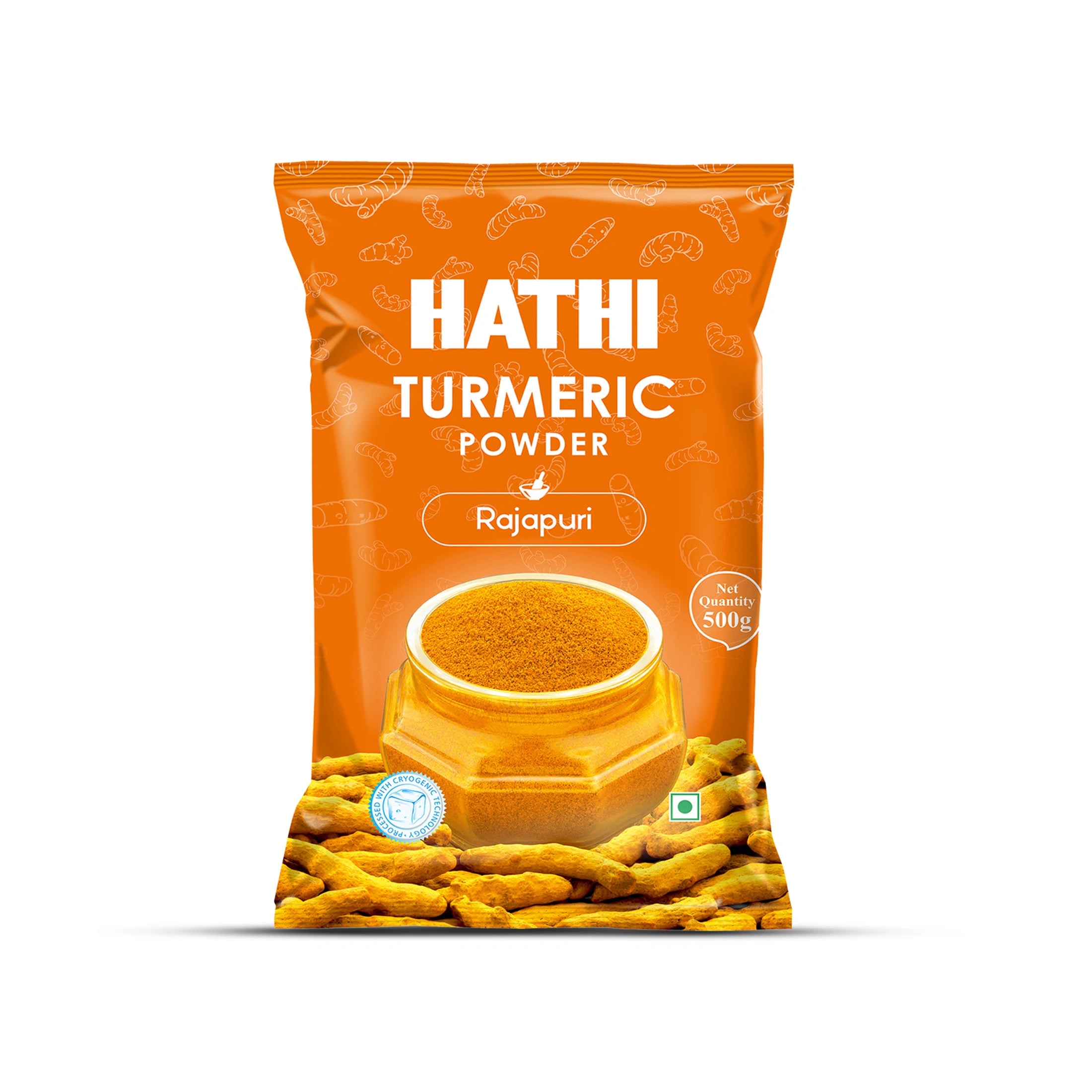
Hathi Masala sells Rajapuri haldi powder for people who want to try this variety. Always read the ingredient list before purchasing the pack.
Selam vs Rajapuri Turmeric: The Differences That Matter in Your Kitchen

1. Colour: Which haldi variety adds a deeper shade?
Selam turmeric is mainly known for a golden-yellow color, while Rajapuri is generally known for a saffron yellow or darker yellow-orange color. These are just a few points, not predecided rules for every haldi packet.
If you and your family prefer color, use both haldis in small amounts in your daily dish. Keep the water, other ingredients, cooking time, and haldi quantity the same. Then compare the finished dishes in a similar background.
Don’t add extra haldi powder to deepen the color. Too much haldi can change the dish's final taste.
Note: Color alone doesn't tell you whether your haldi powder is pure.
2. Fragrance and Flavours: Which is better?
Haldi powder needs a classic fragrance and warm flavor notes. But without testing the actual products, we can’t assume every Selam batch smells gentler, or every Rajapuri batch tastes sharper.
Fragrance and flavor can change with the season, during harvesting, drying, storage, and grinding. A stale or poorly stored haldi powder might smell dusty or weak. dusty or weak.
For an honest comparison at home, use equal amounts of each haldi in the same dish. Smell both haldi powders before cooking, then compare the fragrance and flavour once you finish cooking.
This method helps you decide what your family likes.
3. Texture: Is one powder finer than the other?
Not always. The texture of any haldi powder depends entirely on the grinding process and the mesh size the brand uses. The name alone can’t tell you whether the haldi powder will feel finer or rougher.
A fine powder might mix easily into a dal, gravy, or curry, while a rougher powder can give different results in the same dish. However, you can also grind both haldi varieties to a similar texture.
4. Processing: What should you know?
Before turmeric powder reaches your kitchen shelf, manufacturers clean, treat (if needed), dry, and grind the rhizomes.
Many brands also polish them while processing. These steps can affect turmeric powder's characteristics, including appearance, fragrance, and moisture.
Grinding methods also matter here. Cryogenic grinding technology grinds turmeric at very low temperatures.
It won’t generate heat, making it ideal for preserving heat-sensitive aroma and other compounds. However, this grinding method doesn't prove a specific curcumin amount or guarantee that every nutritional compound remains unchanged.
When comparing 2 turmeric brands, always check the processing and quality-testing information. Many brands or packaging make these claims without proper evidence and use only technical-sounding words.
5. Price: Which haldi powder offers better value?
Higher pricing doesn’t directly prove the quality of the turmeric powder. Compare the price for the same weight, check the ingredient list and packaging information, and consider how much powder you normally use for everyday cooking.
For example, if a packet costs more but provides no reliable information, then the extra cost may not be worth it for you or your family. On the other hand, you might choose a premium haldi variety because you prefer its colour or fragrance.
Always compare the current turmeric price per 100 g or 500 g, not just the amount shown on a product card. Prices and pack sizes can vary, so always check the current listing before buying.
Which Haldi Powder Has More Curcumin Content?
Curcumin is a natural compound that occurs in turmeric. This compound contributes to haldi's yellow color and is often mentioned in spice research. But there’s no single curcumin percentage that applies to every batch of Selam or Rajapuri turmeric powder.
What does published research mention?
A research study published in the African Journal of Food Science checks many haldi varieties grown across Maharashtra. It reported the following ranges for the samples and testing methods used.
|
Variety |
Curcumin range reported in the study |
|
Selam |
2.169% – 5.932% |
|
Rajapuri |
2.812% – 4.366% |
Curcumin and curcuminoids: What are the main differences?
Curcumin is the compound found in turmeric. Curcuminoids are a group of compounds that includes curcumin and related compounds.
A test that measures all curcuminoids might show different percentages than one that measures only curcumin. Results can also vary depending on how researchers extract and test the sample.
This is one reason why two websites may show different numbers for the same variety. Before comparing percentages, check whether both results measure the same thing and use comparable methods.
5 things that can change the result of final powder
-
Conditions while growing: Soil, atmosphere, and the growing season can affect the rhizomes.
-
Processing and drying: Steps before grinding raw haldi can also affect the final powder.
-
Testing method: Different measurement methods, sample sizes, and extraction can yield minor or completely different results.
-
Storage: Date of manufacturing, heat, sun-light, and moisture can affect the quality of stored powdered turmeric.
-
Blending: Haldi powder from multiple sources may have a different formulation than a single-source batch.
What Hathi Masala claims about curcumin?
Hathi Masala has Selam, Rajapuri, and Super turmeric powder in its product range. However, you shouldn’t treat a variety name or a general product-page claim as proof of the curcumin content in the packet you buy.
For a stronger, more reliable comparison, the brand should publish a Certificate of Analysis (COA) for every batch that shows the tested product, laboratory, test date, method, and result.
What are the FSSAI and AGMARK benchmarks?
FSSAI standards require turmeric powder to have at least 2.0% coloring power, measured as curcuminoid content in dry powder.
They also set limits for moisture and other quality factors and prohibit added colors. [Source: FSSAI food standards].
These standards are just general guidelines and don’t mean every pack of haldi powder contains the same amount of curcumin.
AGMARK has its own turmeric grading standards, so check the requirements and product documents before comparing varieties.
Which Haldi Should You Use for Which Dish?
Using either Selam or Rajapuri turmeric in everyday Indian meals is safe. Your choice depends on your family's preferred color and flavor.
|
Dish |
Selam turmeric |
Rajapuri turmeric |
|
Dal and khichdi |
A classic option for a golden-yellow touch |
Also works; compare the shade your family prefer |
|
Kadhi |
Works best in kadhi |
You can try if you want a deeper shade |
|
Shaak and sabji |
Suitable for regular vegetable items |
Works well with the same dishes |
|
Rice dishes |
Use it to add a golden-yellow finish |
Use it for a deeper yellow-orange touch |
|
Athanu (pickles) |
Works with some pickle recipes |
Works, but check the colour and flavour |
|
Homemade masala mixture |
Best to use where a golden-yellow shade is required |
Compare the color of both powder when making a spice blend |
|
Turmeric milk |
Choose any according to your preferred colour and flavour |
Choose any according to your preferred colour and flavour |
|
Pithi or haldi |
Don’t choose only by variety name |
Don’t choose only by variety name |
A simple comparison you can do at home
If you are unsure which powder you have to purchase, try this small test before stocking up:
-
Take 2 similar portions of the same cooked dal or plain rice.
-
Add the same amount of Selam haldi to one and Rajapuri haldi to the other.
-
Make sure the other ingredients and cooking time are the same for both dishes.
-
Compare the appearance and fragrance after cooking.
-
See which result your family prefers.
This simple test can’t measure purity or curcumin content. It only helps you decide which haldi powder suits your family’s cooking style.
Which Haldi Powder Gujarat, Maharashtra and South Indian Kitchens Usually Purchase
Haldi powder preferences vary from family to family. Families that cook dal and sabji regularly may choose a dependable haldi powder. Meanwhile, someone who makes masala blends at home may pay closer attention to appearance, fragrance, and batch quality.
Selam haldi is mainly connected with Tamil Nadu, while Rajapuri haldi is primarily connected with Sangli in Maharashtra.
For buyers across Gujarat, the simplest consideration is to choose the powder based on the dishes you prepare most often.
If you regularly make masala blends at home, compare the freshness, packaging, price per gram, and available quality information of both varieties before buying a larger pack.
How to Evaluate if Your Haldi Powder Is Pure
When you’re purchasing haldi powder, look beyond its appearance. A bright haldi doesn’t automatically mean it's pure, and a darker shade doesn't mean it has more curcumin.
1. Check the packet label carefully
Always check these details given on the pack before purchasing any turmeric powder.
-
Ingredients list: Make sure the product clearly lists all its ingredients.
-
FSSAI info: Check whether the pack mentions the food safety license information.
-
Batch number: This number helps you identify the specific batch if you need to recheck it.
-
Packing date and best-before date: Always purchase a packet with sufficient shelf life.
-
Origin details: Check for clear sourcing information if the origin matters to you.
Check the pack label first, but it can’t prove every aspect of purity.
2. Try the water test suggested by FSSAI as a basic check
FSSAI's DART resources show a simple demo to check certain forms of food adulteration at home. One demonstration for turmeric powder involves dissolving a pinch of powder in a glass of water and observing how it settles.
These home tests are only a basic indication. They can’t confirm that turmeric powder is entirely pure, detect all possible adulterants, or accurately measure curcumin content.
If you have serious concerns about the spices you use, use an appropriate laboratory test rather than relying on home tests alone.
3. Why brighter haldi doesn’t always mean better quality
The color of natural haldi can vary from batch to batch. Never treat an unusually sharp or artificial-looking shade as a sign of premium turmeric.
FSSAI standards have denied and prohibited added coloring matter in turmeric powder, including lead chromate.
Always buy from a seller that gives clear product information and can explain its quality evaluations.
Guide to Buy: How to Choose the Best Haldi Powder
The best haldi powder isn’t necessarily expensive or the one with the biggest curcumin claim. It is the one that meets your own requirements, suits your meals, and offers value.
Use this 6-point checklist while buying the powder
1. Check the ingredients list. Look for clear information and avoid products with vague ingredient descriptions.
2. Check its freshness. Choose a properly sealed pack with a clear manufacturing date, packaging date, and sufficient shelf life.
3. Check its origin. If you’re specific about buying Selam or Rajapuri, check whether the seller explains where their raw turmeric comes from.
4. Ask for the proof behind claims the brand made. A curcumin percentage shouldn’t be supported without a relevant test report. Evaluate the method and whether the figure refers to curcumin content or total curcuminoids.
5. Check the packaging quality. A properly sealed pack helps to protect turmeric powder from direct sunlight, moisture, and air before it reaches your kitchen.
6. Compare price by weight. Check the price per 100 g or 500 g and compare both products of similar quality. Never pay extra because the pack says it’s premium or has high curcumin.
Where you can use regular turmeric powder
If you primarily cook dal, khichdi, sabji, and regular gravies or curries, you may not need a proper turmeric variety. Any fresh, good-quality daily-use haldi that suits your flavor preference and budget will work.
For everyday use, check out Super Turmeric Powder by Hathi Masala. It’s a good-quality, budget-friendly option.
How should we store turmeric powder?
After opening the pack, transfer the turmeric powder to a clean, airtight container. Keep the container in a cool, dry spot away from direct sunlight, heat, and moisture.
Always use a dry spoon to scoop out the powder and close the container properly after every use.
A Straight Note on Health Claims
Haldi is an important spice in Indian cuisine, and many researchers have studied curcumin content for various health effects.
However, lab tests and studies often use concentrated supplements, which may not reflect the effects of using tiny amounts of turmeric powder in everyday meals.
You may have heard that black pepper helps the human body absorb curcumin better. One study examined a small dose of curcumin taken with piperine (a compound found in black pepper). However, this doesn’t mean adding a pinch of black pepper to your food will have the same effect or guarantee any specific health benefits.
Don’t treat Selam or Rajapuri turmeric as a medicine. If you want to use turmeric powder or curcumin supplements for medical purposes, talk to a qualified healthcare professional first.
Selam vs Rajapuri Turmeric
So, which turmeric powder should you purchase? No single haldi fits every Indian kitchen.
Go with Selam turmeric if your family prefers the typical golden-yellow appearance in dishes and you want to try a variety grown in Tamil Nadu.
Choose Rajapuri turmeric if your family prefers a classic deeper yellow-orange color shade or wants to compare a haldi variety grown in Sangli.
Any of these haldi works for daily dal, sabji, khichdi, and kadhi. For any turmeric packet, freshness, purity, processing, price, and batch information matter more than its name.
If you are buying haldi from Hathi Masala, compare Selam Turmeric Powder and Rajapuri Turmeric Powder using the same checklist given above. If you primarily need turmeric for everyday meals, buy Super Turmeric Powder.
Frequently Asked Questions
What is the difference between Selam and Rajapuri turmeric?
Selam turmeric is mainly grown in Selam, Tamil Nadu, while Rajapuri turmeric is grown in Sangli, Maharashtra.
Both turmeric varieties are often described as having different yellow shades, but color and curcumin content depend on the batch, processing, and testing method.
Which haldi has more curcumin content, Selam or Rajapuri?
A few published studies found the common ranges: 2.169%–5.932% for Selam haldi and 2.812%–4.366% for Rajapuri haldi.
These figures don’t guarantee that the curcumin content of a product you purchase is the same. Always compare batch-specific reports that use similar testing methods.
Is Selam haldi the same as Selam haldi?
Yes. The spellings Selam and Selam mean the same turmeric variety in the Indian spice trade. Always check the seller's origin and product details instead of relying only on the spelling and packaging.
Is Rajapuri turmeric the same as Sangli turmeric?
Rajapuri is a trade name for turmeric grown in the Sangli area. Sangli Turmeric has a registered GI designation, but not every packet labeled Rajapuri automatically qualifies to use that GI claim.
Does a deeper colour mean more curcumin?
No. Appearance and color alone can’t directly prove curcumin content or purity. Growing conditions, processing, and storage can affect its color, and artificial coloring can also change its appearance.
Which haldi is best for turmeric milk?
Both Selam and Rajapuri haldi are good for turmeric milk. Choose the one your family prefers for color and flavor. Never choose turmeric milk ingredients based on unverified medical claims.
Which turmeric powder is best for pickles (athanu)?
Both turmeric varieties work well in many pickle recipes. Always start with a small batch of pickles, then compare color and flavor. The best choice always depends on the recipe you’re following and your and your family’s preference.
How do I check whether turmeric powder is pure?
Check the ingredients list first, then look for FSSAI information, batch number, dates, and sourcing details.
A home water test can only give a primary indication and can’t prove complete purity. Proper laboratory testing is perfect for serious concerns.
Can I mix Selam and Rajapuri turmeric?
Yes. Many Indian families mix these two haldi powders for cooking or homemade spice blends.
Start with a small amount, cook a dish with the spice blend, and adjust next time to suit your preferred color and flavor.
Which turmeric powder is best in India?
There is no particular best turmeric for every family. It depends on personal preference. Before buying any haldi, look for a clear ingredients list, freshness, quality checks, sourcing information, supporting proof for curcumin claims, and a fair price.
Is Lakadong haldi better than Selam or Rajapuri?
Lakadong haldi is associated with the Meghalaya region and is best known for its curcumin content.
An honest comparison needs reliable results from comparable tests. The variety name alone cannot prove that one batch is better than another.