











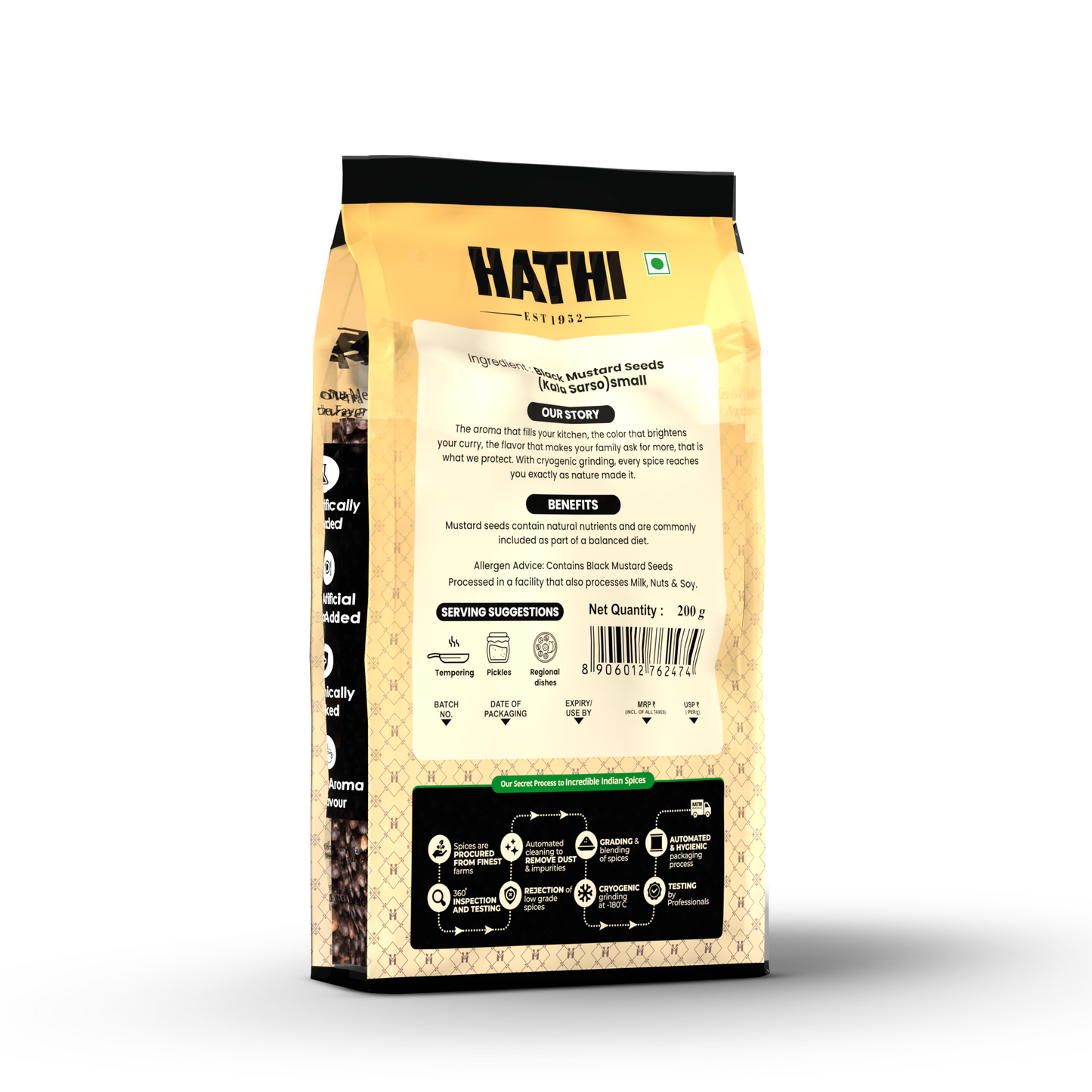
Black Mustard Seeds (Rai) | Crackle Grade, Machine Cleaned


Wholesome
Goodness

Hygienically
Packed

Clinically
Proven

No Artificial
Colors

Notice Stronger
Aroma
Prefer It Over
Regular Pepper
Say It Elevates
Everyday Cooking
Description
Black Mustard Seeds, The Crackle Behind Every Authentic Tadka
Hathi Black Mustard Seeds are crackle-grade rai/sarso that pop instantly in hot oil. Fine-mesh machine-cleaned to remove dust, stone, husk, and impurity from these tiny seeds. Low moisture and high oil content ensure they pop instantly every time you add them to hot oil. Essential for South Indian tempering, Gujarati dal, pickles, and the Bengali whole-spice blend panch phoron.
Why Should Indian Kitchens Trust Hathi Masala?
- Hygienically Packed
- Fresh. Efficient. Pure.
- Lab Tested Every Batch
- Flavour locked packaging
- Exported to 60+ Countries
About Hathi Masala Black Mustard Seeds(Kala Sarso)
Black mustard seeds, known as rai/kala sarso, are used across Indian households. These small, dark, round seeds grow on the Brassica nigra plant. They are one of the most widely used and oldest whole spices in Indian cuisine. These seeds are tiny yet punchy. It has a sharp, slightly bitter edge when it’s raw. The moment it hits hot oil, it transforms completely, pops open, and releases a warm, nutty depth that boosts countless traditional Indian dishes.
Rai isn’t yellow mustard. It’s an entirely separate variety with its own stronger and unique taste. It has a faster crackling reaction to hot oil. If your mustard seeds are slow to crackle or don’t crackle at all, the oil content is too low. Hathi Black Mustard Seeds are selected for high oil content specifically to avoid this.
Sourcing and Origin
Hathi Masala sources black mustard seeds directly from the major producing regions, Rajasthan and Madhya Pradesh. These regions produce seeds with higher oil content due to the dry climate and the sandy, drained soil. Higher oil content means faster crackling. Hathi Masala checks the seeds at the procurement stage for size, moisture, and oil content. Undersized, shriveled, or high-moisture seeds are rejected before they reach the cleaning line.
What Crackle Grade Means and Why It Matters
Most people don’t realize that not every mustard seed behaves the same in a pan. The popping response depends on the oil levels and moisture content. Seeds with high moisture or low oil take a long time to crackle, sometimes don’t crackle at all, and leave a raw, bitter flavour.
Hathi Masala Black Mustard Seeds are processed to achieve low moisture and equal seed size. The fine-mesh automatic cleaning procedure removes dust, stones, Undersized seeds, and other impurities.
When you add Hathi Black Mustard Seeds to hot oil, they should crackle within seconds. That fast crackle is the signal that the oil content is high and the seeds are releasing their flavours into the oil properly.
How to Use Black Mustard Seeds in Your Kitchen
They’re almost always used as the first ingredient in a tadka (tempering). They go into pre-heated oil first, and must crackle before the next ingredient.
- For South Indian Tadka (Tempering): Add 1/2 tsp of kala sarso seeds in the pre-heated oil. Wait for them to crackle completely. Then add other whole spices. This is the base for most South Indian dishes.
- For Gujarati Dal and Kadhi: Add 1/2 tsp kala sarso/rai to the hot ghee tadka along with jeera. Let them crackle and pour it over the dal.
- For Pickles (Achar): Use 1-2 tsp of whole black mustard seeds per 500g of pickle base. They add heat and a preserving function. Roughly ground kala sarso seeds are also used in mustard-based pickle.
- For Bengali Panch Phoron: Black mustard seeds are one of the five seeds in the panch phoron mix. Use equal parts of kala sarso, jeera, methi, kalonji, and saunf. Toast lightly in oil before adding vegetables or fish.
- For Chutneys and Raita: Crackle 1/4 tsp kala sarso in hot oil and pour over fresh chutneys, coconut chutney, or boondi raita for the final seasoning.
Black, Yellow & Brown Mustard: What are the Differences?
Many home cooks confuse sarso with other types of mustard available in the Indian market or on e-commerce platforms. This table clarifies the differences:
|
Feature |
Black Mustard Seeds (Rai) |
Yellow Mustard Seeds |
Brown Mustard Seeds |
|
Plant |
Brassica nigra |
Sinapis alba |
Brassica juncea |
|
Colour |
Dark brown to black |
Light yellow |
Reddish brown |
|
Size |
Small |
Large |
Medium |
|
Flavour notes |
Sharp, nutty when cooked |
Mild, slightly sweet |
Slightly pungent and strong |
|
Crackling in oil |
Fast, intense |
Slower |
Moderate |
|
Primary use |
South Indian tadka, pickles, Bengali spice mix |
Western mustard sauce, European cooking |
North Indian pickles, mustard oil |
|
Common name |
Rai, Kala Sarso |
Safed Sarso |
Lal Sarso |
If the seed is large and pale, it’s yellow mustard, and it’ll not behave like rai in your tadka. Hathi Black Mustard Seeds are the small, dark variety used in Indian tempering and tadkas.
Benefits of Black Mustard Seeds in Your Diet
One of the most nutrient-dense tiny seeds in the Indian whole spice collection. They are a natural source of minerals such as selenium, magnesium, and omega-3 fatty acids. The glucosinolates in mustard seeds are responsible for their strong flavor and have antioxidant properties.
Mustard seeds are also a source of fiber and contain small amounts of iron, calcium, and zinc. In Ayurveda, it has been used to promote digestion and as a warming spice for colds. It’s naturally gluten-free and contains no artificial additives.
These are the spice's natural properties. They aren’t medical claims and don’t replace medical advice.
Storage: Store the black sarso seeds in an airtight glass or plastic jar. Keep it in a cool, dry spot away from direct sunlight and moisture. Use within 12 months upon opening for best crackling performance. Hathi Masala’s 3-layer sealed packaging protects the moisture balance until you open the pack.
Quality You Can Trust
Hathi Masala has been a part of Indian spice manufacturing since 1952. Black mustard seeds are processed through a fine-mesh, fully automated cleaning machine designed for small seeds. It removes stones, dust, Undersized seeds, and impurities before packaging. Every batch is lab-tested for moisture, purity, and safety.
- FSSAI-Certified and ISO 22000 Manufacturing.
- Lab tested every batch.
- Low moisture drying Technology
- Hygienically Packed. Dedicated sterilization facility.
- Flavour-locked packaging
More from the Hathi Masala Kitchen
Explore related categories:
Salts - Black Salt, Rock Salt & Pink Salt for better taste and daily use
Blended Spices, Kitchen King, pav bhaji, chana masala & more
Pickle Masala, Ready-to-use masala mixes for homemade achars.
Recipes
History & Source
Ingredients
FAQ

Spice up your kitchen


