











Javitri (Mace Spice) | Bright Orange Blades, Kerala Origin


Wholesome
Goodness

Hygienically
Packed

Clinically
Proven

No Artificial
Colors

Notice Stronger
Aroma
Prefer It Over
Regular Pepper
Say It Elevates
Everyday Cooking
Description
Whole Javitri, The Floral Spice of Every Traditional Indian Kitchen
Javitri is the bright red, lacy cover that wraps around the nutmeg kernel. Hathi sources it fresh from Kerala, every batch is lab-tested, and sealed in protective packaging to preserve its natural colour and aroma. Hathi Masala is selling Whole blades, not crushed. It’s perfect for biryani, Mughlai curries, pickles, and sweet dishes.
What Makes Hathi Masala Worth Adding to Your Kitchen?
- Hygienically Packed
- Fresh.Effiecient. Pure
- Lab Tested Every Batch
- Flavour locked packaging
- Exported to 60+ Countries
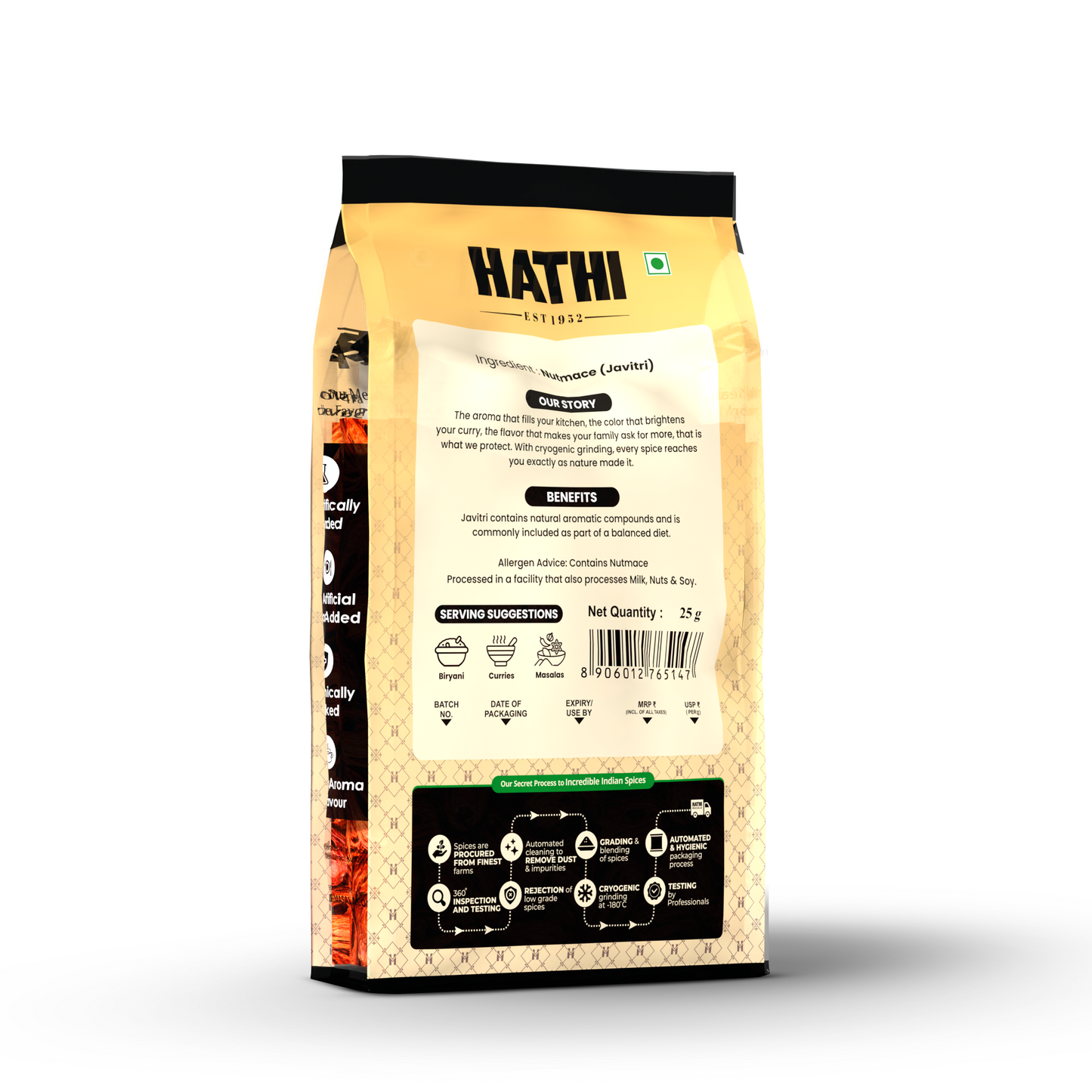
About Hathi Masala Javitri (Nutmace )
What Is Nutmace (Javitri)?
Javitri is the lace-like aril that wraps around the nutmeg seed inside the nutmeg fruit. Once the fruit is harvested and cut open, this bright red-orange layer is carefully peeled away and dried. During the drying process, the color turns to the rich orange seen in the packet.
The two spices Jaifal (Nutmeg) and javitri (Nutmace) are obtained from the same fruit, nutmeg, but they have completely different properties. Though Nutmace has a delicate fragrance compared to nutmeg. It’s more aromatic and has a sweet, spicy taste. On the other hand, Jaifal has a musky aroma and a spicy taste.
In India, Nutmace can be found in garam masala mixes, biryani dishes, and Mughlai gravies. In addition, Nutmace can be found in slow-cooked meat dishes. It’s a background spice, one that does not announce itself but is immediately noticeable by its absence.
Sourcing and Origin
Hathi Masala sources javitri from Kerala, India's primary nutmeg-growing region along the Malabar and Konkan coasts. The coastal humidity and laterite soil of these farms produce blades with deep red-orange colour and high essential oil content, two markers of Nutmace quality. Sourcing directly from these farms allows for quality checks at the grading stage before the blades are packed.
How Hathi Masala Processes and Packs Javitri
Javitri is one of the most fragile whole spices. The blades are thin and highly sensitive to light, heat, and moisture, all of which fade the color and strip the essential oils that carry the aroma.
At Hathi Masala, Nutmace blades are hand-sorted after drying nicely to remove any crushed or broken pieces, as these indicate rough handling and decreased oil content. Each batch is lab-tested for moisture content and quantity of its natural essential oils before packaging. The final packaging is light-protective and sealed to preserve the orange color and aroma on the shelf.
How to Use Javitri in Your Kitchen
- Biryani: Add 1-2 whole blades to the hot oil or ghee at the beginning, along with the other whole spices. Let them crackle for 20-30 seconds before adding onions.
- Mughlai gravies and korma: Add 1-2 Nutmace blades into the whole spice mix while building the base. Nutmace is a core flavour in most Mughlai gravies. Its floral note separates a proper korma from an ordinary one.
- Sweet dishes: A pinch of powdered javitri in kheer, shrikhand, or halwa desserts. Javitri is an excellent companion to dishes made with milk, cardamom, and saffron, providing a fragrance that does not overwhelm other flavors.
Benefits of Javitri in Your Diet
Javitri (Nutmace) comes from the same fruit as Jaifal (Nutmeg), and both spices contain similar compounds, such as myristicin, elemicin, and eugenol, although in different amounts. Nutmace, however, contains lower levels of the active compounds and is a bit easier to cook, and both spices carry antioxidant and digestive properties. Besides, Nutmace has long been used in Ayurvedic Indian cuisine and is gluten-free and additive-free.
These are natural properties of nutmace. They aren't a medicine and don’t replace medical advice.
Storage: Store Hathi Masala Nutmace in an airtight container away from moisture and direct sunlight. The blades of nutmace are light-sensitive. Sunlight fades the orange color and weakens the natural fragrance of its essential oils.
Quality You Can Trust
Hathi Masala has been manufacturing spices since 1952. Every batch of javitri is sorted for intact blades only and tested for moisture and essential oil content before packing. 3-layer light-protecting, sealed packaging that preserves the elegant orange colour and fragrance throughout the shelf life.
- FSSAI-Certified and ISO 22000 Manufacturing.
- Lab tested every batch.
- Cryogenic Grinding Technology
- Hygienically Packed. Dedicated sterilization facility.
- Flavour-locked packaging
More from the Hathi Masala Kitchen
Explore related categories:
Salts - Black Salt, Rock Salt & Pink Salt for better taste and daily use
Blended Spices, Kitchen King, pav bhaji, chana masala & more
Pickle Masala, Ready-to-use masala mixes for homemade achars.
Recipes
History & Source
Ingredients
FAQ

Spice up your kitchen


