











Yellow Mustard Seeds (Peeli Sarson) | High Oil, Pickle Grade


Wholesome
Goodness

Hygienically
Packed

Clinically
Proven

No Artificial
Colors

Notice Stronger
Aroma
Prefer It Over
Regular Pepper
Say It Elevates
Everyday Cooking
Description
Yellow Mustard Seeds, The Seed That Starts Every Good Pickle
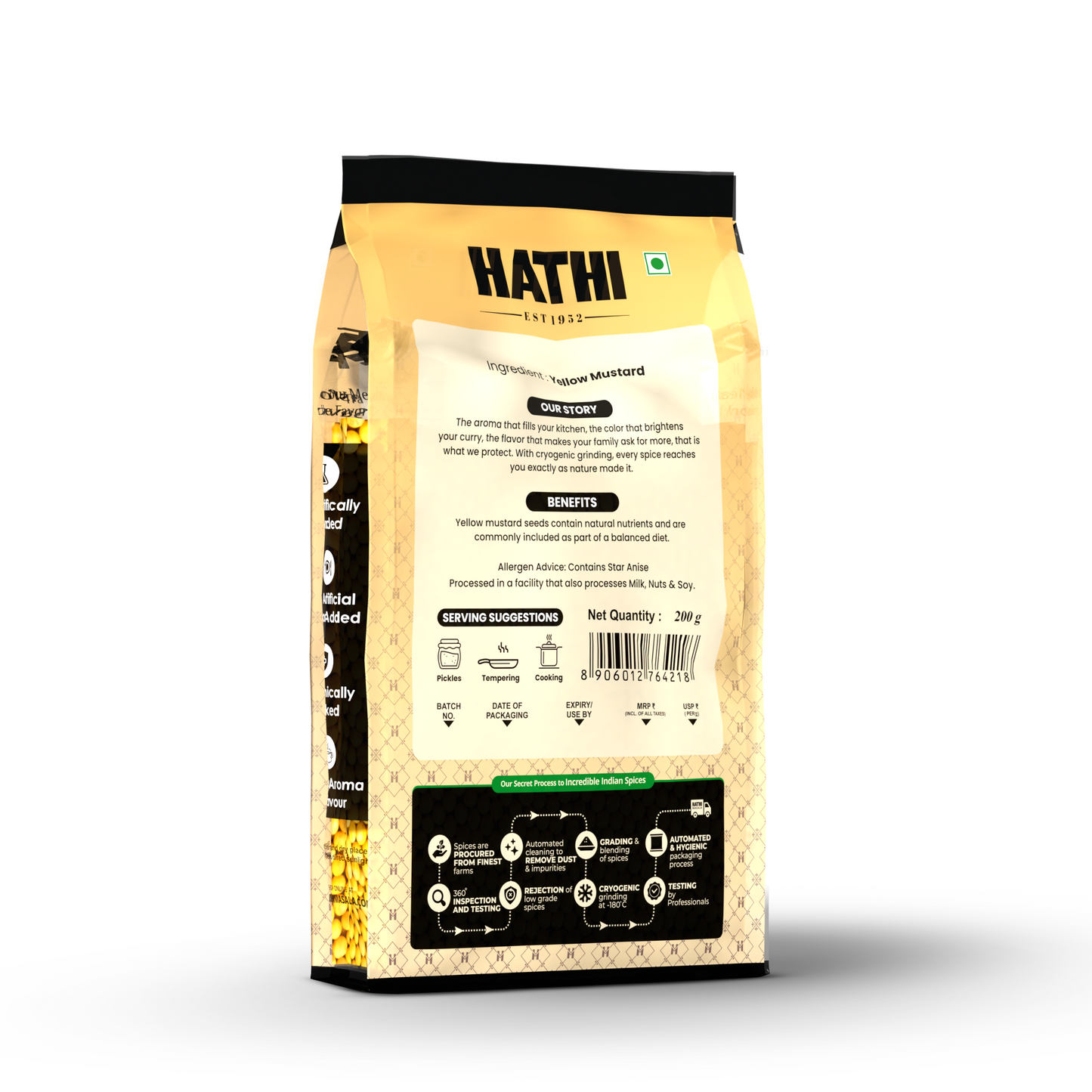
Good-quality, rich in essential oil, yellow mustard seeds are selected for their role in pickles and paste. Machine-cleaned for consistently sized seeds and zero debris. Lab-tested for essential oil content, which is responsible for paste consistency and pickling performance. It has a milder flavour than black mustard, with a slightly bold taste that works well when ground into a paste, added to the achar, or used in Bengali kasundi.
Why is Hathi Masala Pilli Sarso a Reliable Choice for Pickles?
- Hygienically Packed
- Fresh. Efficient. Pure.
- Lab Tested Every Batch
- Flavour locked packaging
- Exported to 60+ Countries
About Hathi Masala Yellow Mustard (Pilli Sarso)
Yellow mustard seeds are also known as Peeli Sarson in most Indian households. They’re the pale, round seeds rhat grows from the Sinapis alba plant. They are larger in size than black mustards and noticeably milder in flavour. When they’re raw, they carry a faint bitterness. When soaked and ground, they give a smooth, rounded sharpness that creates the base of most Indian pickles, Bengali kasundi, and homemade mustard paste.
Peeli Sarson can’t be used as a replacement for black mustard. It’s a different spice for different kitchen tasks. Its value is in the paste, the pickle, and the marinade, not in the tadka. If your recipe calls for ground mustard paste or mustard-based pickle, this is the variety you need.
Sourcing and Origin
Hathi Masala sourced yellow mustard seeds from the reliable regions across Rajasthan and Madhya Pradesh. These are India's two largest mustard-producing regions. The dry surroundings and well-drained soils of these regions produce seeds with high natural oil content. Oil content is the most important quality factor in yellow mustard seeds. More oil gives a smoother paste and better performance in pickles.
Each batch of Hathi Masala Yellow Mustard Seeds is evaluated for seed size, moisture content, and oil content. Faulted, undersized, or high-moisture seeds are rejected before processing. Only uniform, completely dried, rich-in-essential-oil seeds are accepted for processing.
How to Use Yellow Mustard Seeds in Your Kitchen
For Homemade Mustard Sauce: Soak 3-4 tablespoons of mustard seeds in water/ vinegar for 6-8 hours. Strain them, and grind with vinegar, turmeric, and salt until you get the consistency you prefer.
For Achar Masala (Pickle): Add 1-2 tablespoons of roughly ground seeds per 500g of pickle masala mix. Pilli sarso adds flavour and acts as a preservative in raw mango achar, lemon pickle, and mixed vegetable pickle.
For Fish and Vegetable Tempering: In Bengali cooking, add pilli sarso to hot mustard oil as the base for fish curries. This sarso crackles more slowly and gently than kali sarso.
For Mustard-Based Marinades: Grind 2 tablespoons of pilli sarso, then make a smooth paste and mix it with yoghurt, turmeric, and salt to get a traditional Bengali Mustard-based marinade for fish, vegetables, or chicken.
Black, Yellow & Brown Mustard: What are the Differences?
Many home cooks confuse sarso with other types of mustard available in the Indian market or on e-commerce platforms. This table clarifies the differences:
|
Feature |
Yellow Mustard |
Black Mustard (Rai) |
Brown Mustard |
|
Plant |
Sinapis alba |
Brassica nigra |
Brassica juncea |
|
Colour |
Light yellow |
Dark brown to black |
Reddish brown |
|
Size |
Large |
Small |
Medium |
|
Flavour notes |
Mild, slightly sweet |
Sharp, nutty when cooked |
Slightly pungent and strong |
|
Crackling in oil |
Slower |
Fast, intense |
Moderate |
|
Primary use |
Western mustard sauce, European cooking |
South Indian tadka, pickles, Bengali spice mix |
North Indian pickles, mustard oil |
|
Common name |
Safed Sarso |
Rai, Kala Sarso |
Lal Sarso |
If the seed is large and pale, it’s yellow mustard, and it’ll not behave like rai in your tadka. Hathi Black Mustards are the small, dark variety used in Indian tempering and tadkas.
Benefits of Yellow Mustard Seeds in Your Meals
Yellow mustard seeds are naturally rich in minerals, including selenium and magnesium, as well as omega-3 fatty acids. The active compounds, glucosinolates, are responsible for their strong flavour and antioxidant properties. They are naturally gluten-free. In traditional Ayurveda, pili sarso is classified as a warming spice that supports digestion. Indian households across Bengal, Odisha, and North India have used it in cooking every day for ages, as a spice and as mustard oil.
These are the natural properties of spice. They aren’t medical claims and don’t replace medical advice.
Storage: Store pilli sarso in an airtight glass or plastic jar. Keep it in a cool, dry spot away from direct sunlight and moisture. Use within 12 months upon opening for the best pickling outcomes. Hathi Masala’s 3-layer sealed packaging protects the moisture balance until you open the pack. Ground mustard paste should be refrigerated and can be used within 2 weeks.
Quality You Can Trust
Hathi Masala has been a part of Indian spice manufacturing since 1952. Yellow mustard seeds are processed through a fine-mesh, fully automated cleaning machine designed for small seeds. It removes stones, dust, Undersized seeds, and impurities before packaging. Every batch is lab-tested for moisture, purity, and safety.
- FSSAI-Certified and ISO 22000 Manufacturing.
- Lab tested every batch.
- Low moisture drying Technology
- Hygienically Packed. Dedicated sterilisation facility.
- Flavour-locked packaging
More from the Hathi Masala Kitchen
Explore related categories:
Salts - Black Salt, Rock Salt & Pink Salt for better taste and daily use
Blended Spices, Kitchen King, pav bhaji, chana masala & more
Pickle Masala, Ready-to-use masala mixes for homemade achars.
Recipes
History & Source
Ingredients
FAQ

Spice up your kitchen


