











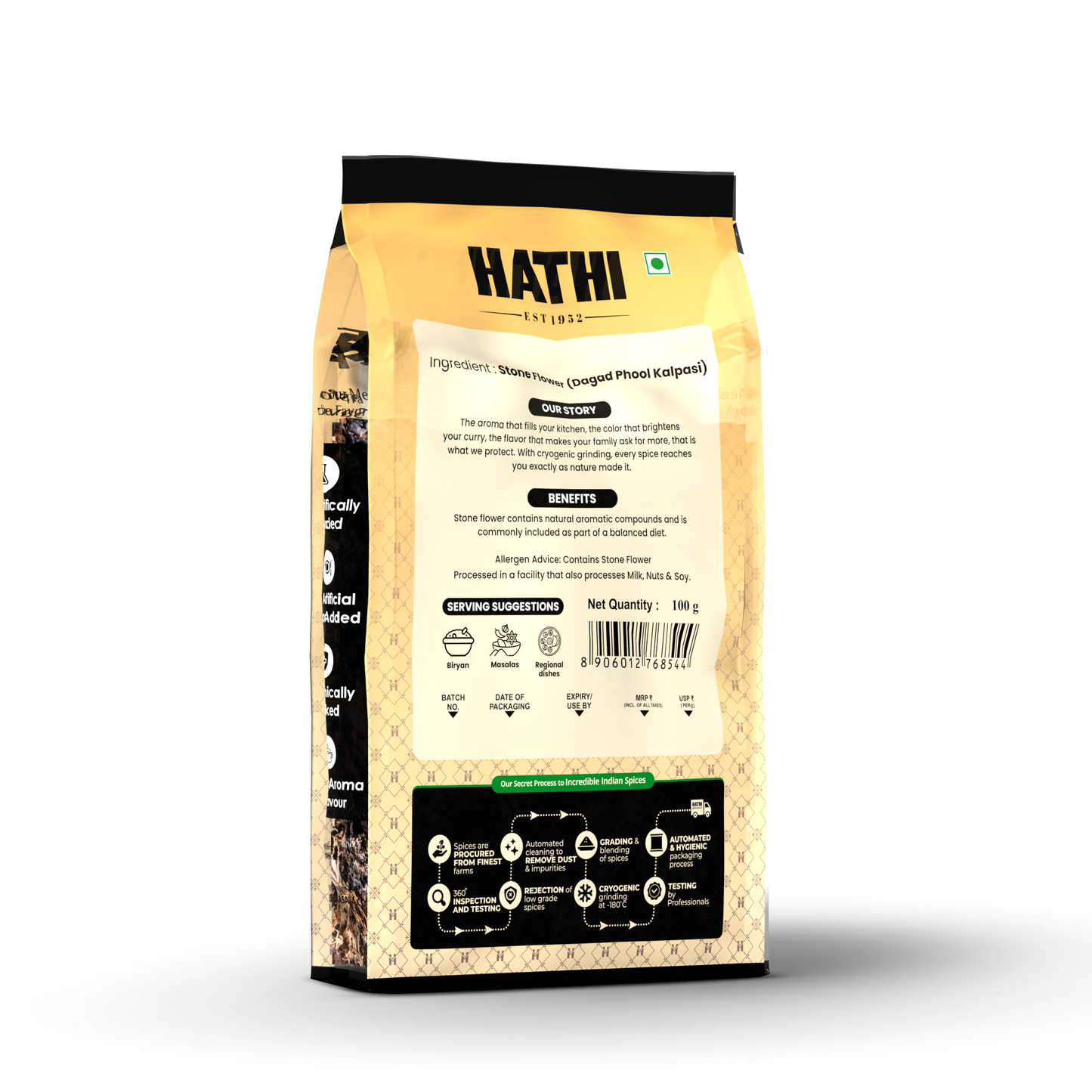
Stone Flower (Dagad Phool / Kalpasi) | Western Ghats Lichen, Rock Debris Free


Wholesome
Goodness

Hygienically
Packed

Clinically
Proven

No Artificial
Colors

Notice Stronger
Aroma
Prefer It Over
Regular Pepper
Say It Elevates
Everyday Cooking
Description
Stone Flower, The Forgotten Spice That Makes the Difference
Hathi Masala Stone Flower is an edible lichen hand-harvested from the forests of the Western Ghats. This spice is also known by multiple names, such as dagad phool in Marathi and Hindi, kalpasi in Tamil. Machine-cleaned to remove fine impurities that naturally stick to this spice at harvest. It has a dry, fluffy texture and a deep, woody fragrance that only smells when exposed to heat or oil. This whole spice is irreplaceable in authentic Goda Masala and Chettinad spice mixes.
What Makes Hathi Masala Unique?
- Hygienically Packed
- Fresh. Efficient. Pure.
- Lab Tested Every Batch
- Flavour locked packaging
- Exported to 60+ Countries
About Hathi Masala Stone Flowers
Stone flower (Parmotrema perlatum) is one of the unusual whole spices used in Indian households. It isn’t actually a flower. It’s an edible lichen that grows naturally on rocks and tree bark in humid forest areas. It is known by different names across India: dagad phool in Marathi and Hindi, kalpasi in Tamil, and kallu hoovu in Kannada.
This spice is dry and papery, with a dark brown-to-black exterior and a lighter interior. In its raw form, it won’t smell of anything. But it releases a deep, earthy, woody aroma the moment it comes into contact with hot oil, ghee, or a dry pan.
Sourcing and origin
Hathi Masala sources dagad phool from the Western Ghats in Kerala, where this grows wild on rocks and tree bark in humid forests. It’s hand-harvested in its naturally dried form, exactly as it has been for ages. But as it grows directly on rock surfaces in open environments, every flower naturally contains impurities, such as sand, dust, and tiny rock beneath its surface. Most dealers in the market don’t clean it. Those impurities go straight into your spice grinder or tadka.
How Hathi Masala Processes Stone Flower
Every batch of Hathi Masala Dagad Phool undergoes an automated machine-cleaning process specifically designed for whole spices. Dagad phools are dry, papery, and easily crumble if handled improperly. So the cleaning is gentle enough to remove every bit of sand and rock debris while keeping the whole lichen intact. No crushing, no shortcuts. By the time you open it, it is clean, whole, and ready to go straight into your pan. No pre-washing needed at home.
Stone Flower Across Indian Regional Cuisines
This spice is connected to multiple regional traditions. It isn’t an item to use regularly, but in the cuisines where it’s used, it’s non-negotiable.
|
Region |
The stone flower used in |
The role of Stone Flower |
|
Maharashtra |
Goda Masala mix |
Gives a rich colour and earthy base |
|
Chettinad (Tamil Nadu) |
Chettinad Masala mix |
Core aromatic, used in spice mixes |
|
Hyderabad |
Bhojwar Masala mix |
Adds woody depth to slow-cooked dishes |
|
Lucknow |
Masala Potli |
Tied into spice pouches |
How to Use Stone Flower in Your Kitchen
It needs heat to release its aroma. It can’t work raw. There are two standard and traditional ways to use it.
= Dry roasting: Take 2-3 pieces and roast them for 30-45 seconds in a dry pan over a low to medium flame, until you can smell the sharp, earthy fragrance. Grind them whole in a masala grinder or spice blender.
- In hot oil or ghee (for tadka): Add 2-3 pieces to the pre-heated oil or ghee at the beginning of your tadka. It will release its aroma within 20-30 seconds. It works well in biryani, dals, and slow-cooked curries.
- For goda masala: Dry-roast dagad phool separately before grinding with the other whole spices. It gives both colour and flavour to the blend. We usually have around 4-5 pieces per batch.
- For potli masala: Add whole pieces directly to the spice pouch without roasting them. The slow-cooking process gradually releases the aroma.
Benefits of Stone Flower
It is a dried lichen that grows naturally in moist forests on tree bark and rocks. It’s hand-collected from the forests, which is what makes it rare and special. In Indian households, it has been used for ages as a whole spice that quietly adds a smoky, earthy flavour to dishes and spice blends without overpowering them.
The natural compounds in stone flower are its antioxidants and aromatic oils. These natural compounds have made dagad phool a valued ingredient in Ayurveda for centuries. It’s gentle on the stomach, supports digestion, and helps to reduce bloating.
These are its natural properties. They aren’t a medicine and don’t replace medical advice.
Storage: Store dagad phools in an airtight glass or plastic jar. Keep it in a cool, dry spot away from moisture and direct sunlight. Because it is a lichen, it’s sensitive to humidity. It softens and loses its dry, fluffy texture when it comes into contact with moisture. Best consumed within 12-14 months of opening.
Quality You Can Trust
Hathi Masala has been part of Indian spice manufacturing since 1952. Our stone flowers are cleaned using a 9-step automatic cleaning machine that removes the sand and rock debris. Every batch of Hathi Masala Stone flowers is tested for purity, moisture, and safety before dispatch. Hygienically packed with zero direct hand contact at any stage.
- FSSAI-Certified and ISO 22000 Manufacturing.
- Lab tested every batch.
- Low moisture drying Technology
- Hygienically Packed. Dedicated sterilization facility.
- Flavour-locked packaging
More from the Hathi Masala Kitchen
Explore related categories:
Salts - Black Salt, Rock Salt & Pink Salt for better taste and daily use
Blended Spices, Kitchen King, pav bhaji, chana masala & more
Pickle Masala, Ready-to-use masala mixes for homemade achars.
Recipes
History & Source
Ingredients
FAQ

Spice up your kitchen


