









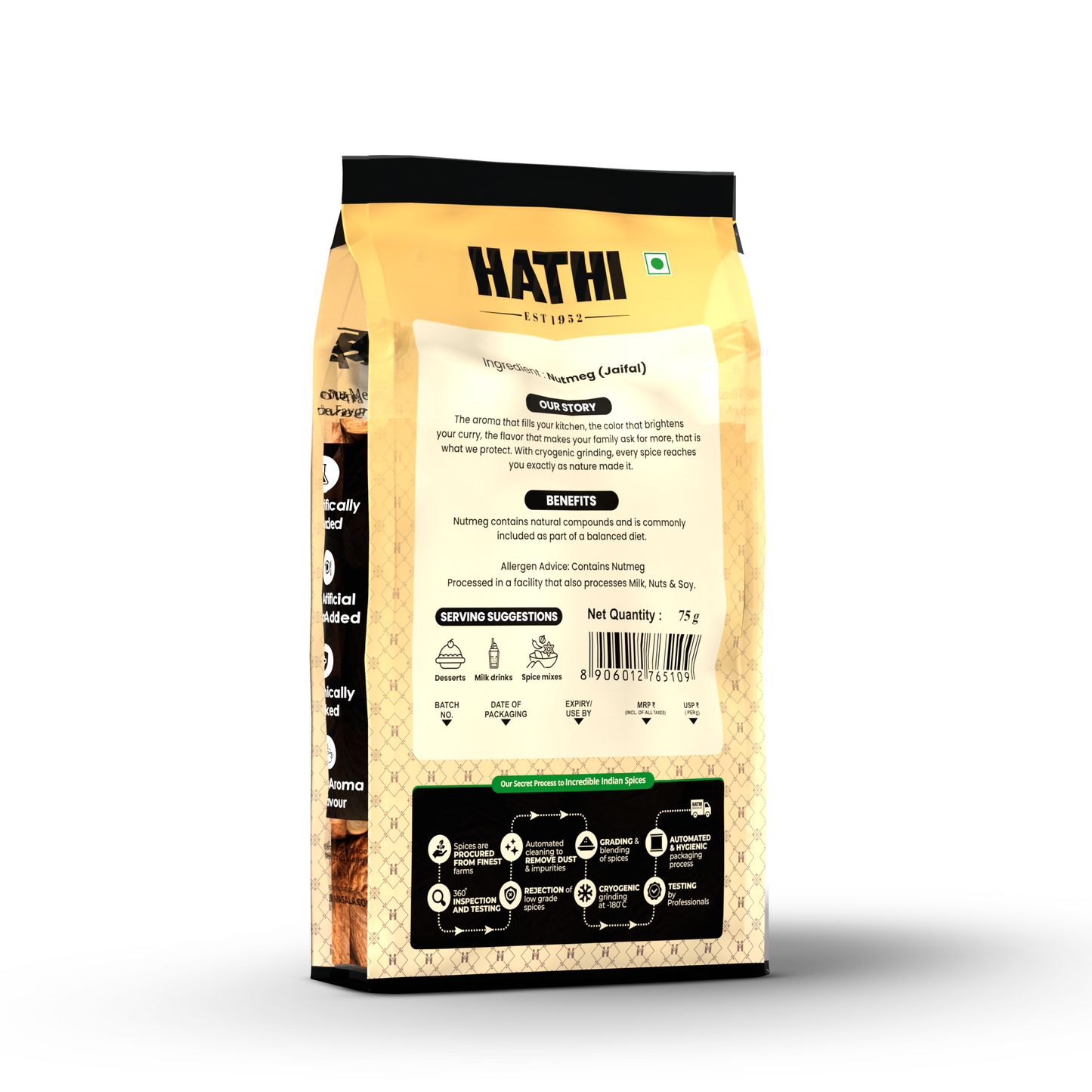
Whole Nutmeg (Jaifal) | A Grade, Heavy Kernels, Bore Free


Wholesome
Goodness

Hygienically
Packed

Clinically
Proven

No Artificial
Colors
84%
Notice Stronger
Aroma
91%
Prefer It Over
Regular Pepper
76%
Say It Elevates
Everyday Cooking
Description
Whole Nutmeg, The Warm Secret of Every Indian Household
Hathi Masala carefully picks A-grade whole nutmeg kernels. Each weighing 6-7 grams, ensuring they’re dense and free of bore holes. Each batch is lab tested for oil content and packed in 3-layer low-moisture packaging to keep them mold-free and fresh.
Grate fresh jaifal directly into your garam masala mix, warm milk, kheer, or biryani for a flavour and natural fragrance that no powder can match.
What Makes Hathi Masala Whole Nutmeg Stand Out?
- Hygienically Packed
- Fresh.Effiecient. Pure
- Lab Tested Every Batch
- Flavour locked packaging
- Exported to 60+ Countries
About Hathi Masala Nutmeg (Jaifal)
What Is Jaifal(Nutmeg)?
Whole nutmeg (jaifal) is the dried seed of the Myristica fragrans tree. It mainly imports from Indonesia but is also grown along India's Malabar and Konkan coasts. The kernel is enclosed in a hard shell, which is removed before grading and packing.
It has a warm, woody, and light sweet aroma, and an intense, sharp odor when freshly grated. In traditional Indian dishes, it’s used in small quantities as a finishing spice. In dishes like biryanis, garam masala mix, and slow-cooked gravies. It’s also commonly used in warm milk, halwa, kheer, and Mughlai dishes.
The natural fragrance of jaifal comes from a compound known as myristicin. Whole seeds holds its aroma longer than readymade powder. That’s why freshly grated jaifal always tastes and smells noticeably better than anything from a container.
Sourcing and Origin
Hathi Masala sources A-grade, export-quality whole nutmeg seeds from Kerala and Karnataka. These are India's primary jalfal-growing states along the Konkan and Malabar coasts. The humidity and laterite soils of these regions produce jaifal with high, potent essential oil content. Sourcing from domestic farms allows for direct quality checks at the grading stage before the kernels are packed.
How Hathi Masala Grades and Processes Whole Nutmeg
The grading procedure for whole seed is more important than for most other whole spices because defects are hidden inside the seed, not visible from the outside. The two main problems that reduce the quality of whole jaifal are bore holes and internal mold.
Bore Holes Bore holes are caused by a small insect known as the nutmeg weevil, which burrows into the jaifal kernel from the inside. The kernel looks normal from the outside, but has lost most of its flavour and natural oil. It weighs less and gives almost no aroma when grated.
Internal Mold Internal mold develops when jaifal kernels with high moisture are sealed before proper drying. The mold grows inside the seed and isn’t visible until the seed is cut or grated. This makes it unsafe to consume.
How Hathi Masala Ensures Quality Hathi Masala selects only A-grade kernels weighing 6-7 grams. At this weight, kernels affected by bore holes or mold are automatically screened out as they weigh comparatively less. Every batch is lab-tested for moisture and myristicin levels before packaging, and it’s sealed in low-moisture packaging to keep it fresh until you use it.
How to Use Whole Nutmeg in Your Kitchen
- Garam masala: Grate a small piece, roughly the size of a quarter kernel, into your garam masala blend along with cardamom and cloves. It is a finishing spice. Use it last and in small quantities.
- Warm milk and haldi doodh: Add 1-2 gratings of jaifal directly into hot milk before serving. It adds warmth and a light, earthy note that goes well with green cardamom and saffron.
- Kheer and halwa: Add freshly grated jaifal as a final touch after cooking. Heat destroys the myristicin compound quickly, so add it at the end, not during cooking.
- Biryani and Mughlai gravies: A small grating of jaifal goes into the whole spice mix or the marinade. It is part of the base flavor architecture of most Mughlai masala pastes.
- How to grate: Use the fine side of a box grater. Grate only what you need. Store the remaining kernel in an airtight box. Never pre-grate and store as powder. The aroma evaporates within hours.
A Quick Grade Guide: Choose the Right Quality for Your Daily Needs
|
Grade |
Weight |
Characteristic |
Bore Holes |
Usages |
|
A Grade (Hathi) |
6-7g |
Dense, high in oil, fully potent aroma |
Zero tolerance |
Garam masala, warm milk, and desserts |
|
B Grade |
5-7g |
Moderate density, Medium oil |
Occasional |
Spice mixtures, General regular cooking |
|
C Grade / Mixed |
Below 5g |
Light, weak aroma, lower oil |
Common |
Industrial grinding only |
Benefits of Nutmeg in Your Diet
It contains myristicin, elemicin, and eugenol, compounds that add to its warm, resinous character and studied properties. In Ayurvedic practice, a small scraping of jaifal in warm milk has long been used as a sleep aid and digestive support, particularly for post-meal heaviness. Jaifal is a source of manganese, copper, and magnesium. It also contains small amounts of dietary fiber. Because of its potency, itis used in very small quantities, typically a few gratings per serving, which means a whole kernel lasts several weeks of regular use.
Jaifal, in large quantities, can be harmful beyond culinary use. Use only in normal cooking amounts. These are natural dietary properties and do not replace medical advice for any health condition.
Storage: Store Hathi Masala whole nutmeg in an airtight container in a dark, dry place. Avoid pre-grating and storing. Should be used up within two years of packaging. The whole seed will hold its myristicin and flavor for much longer..
Quality You Can Trust
Hathi Masala has been manufacturing spices since 1952. Every whole kernel is graded at 7g or above to screen out borehole-affected and low-oil kernels before packing. Each batch is lab-tested for myristicin content, moisture, aflatoxin, and microbial safety. Sealed in low-moisture packaging designed to prevent internal mold after packing.
- FSSAI-Certified and ISO 22000 Manufacturing.
- Lab tested every batch.
- Cryogenic Grinding Technology
- Hygienically Packed. Dedicated sterilization facility.
- Flavour-locked packaging
More from the Hathi Masala Kitchen
Explore related categories:
Salts - Black Salt, Rock Salt & Pink Salt for enhanced taste and daily use
Blended Spices, Kitchen King, pav bhaji, chana masala & more
Pickle Masala, Ready-to-use masala mixes for homemade achars.
Recipes
History & Source
Ingredients
FAQ

Spice up your kitchen